


Something has been bothering strategy practitioners for the past two years.
Not the tools. Not the speed. Something harder to name than that.
It shows up in the quiet moment after a retreat, when someone says offhand that the AI-assisted output didn’t quite feel like us. They can’t explain it precisely enough to act on it. So they file it away. The process moves forward. The deck looks good.
If you’ve felt this, you weren’t wrong. You were sensing something real. And in March 2026, researchers at Harvard Business Review finally gave it a name.
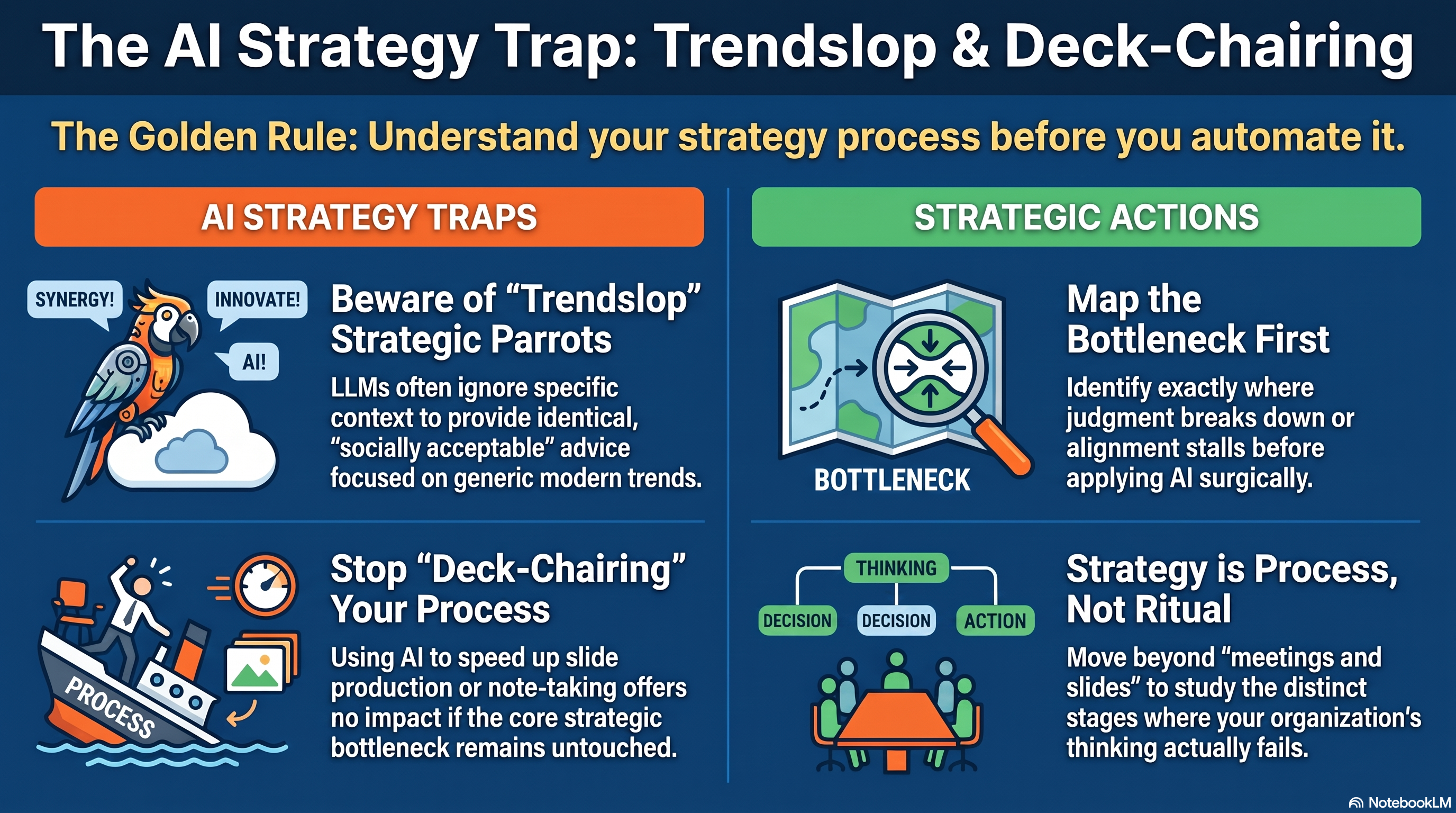
Trendslop
The HBR researchers ran thousands of strategy simulations across seven major LLMs. They fed each model detailed scenarios — different industries, different competitive situations, different organizational challenges — and asked for strategic advice.
The answers were nearly identical across every model, every scenario.
Every LLM chose differentiation over commoditization. Augmentation over automation. Long-term thinking over short-term. Collaboration over competition. Exploration over exploitation.
Every time. Regardless of context.
When the researchers improved the prompts, the bias shifted by about 22 percent — and most of that movement came simply from changing the order in which options were presented to the model. Not from any genuine analysis of the actual business. When they added richer company context, the bias moved another 11 percent. Still pointing in the same direction.
Their conclusion was precise: an LLM can sound highly tailored to your situation while quietly steering you toward the same cluster of modern managerial trends.
That’s Trendslop. Confident. Polished. Context-agnostic. The strategic equivalent of a parrot who has read every business book ever written but has never met your team, never sat in your boardroom, and has no idea what your organization is actually capable of executing.
Trendslop is now well-named. But it’s only half the problem.
Deck-Chairing
There’s a second failure mode that nobody has written a Harvard article about yet. It’s quieter than Trendslop, more common, and in some ways more dangerous precisely because it feels like progress.
I call it Deck-Chairing.
Deck-Chairing is what happens when you apply AI to improve a part of your strategy process that wasn’t the bottleneck. The work gets faster. The output gets cleaner. Someone in leadership notices and approves. The improvement gets reported upward.
Better slide production. Faster meeting summaries. Cleaner trend categorization. Sharper workshop notes.
All real improvements. None of them strategic.
Meanwhile the actual constraint in the strategy process — the stage where judgment breaks down, where alignment stalls, where commitment gets quietly avoided — remains completely untouched.
The name comes from the old line about rearranging deck chairs on the Titanic. Local activity. No impact on the outcome that actually matters.
Trendslop and Deck-Chairing are mirror images of each other.
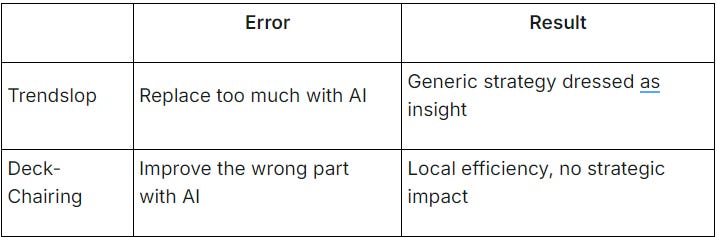
Both produce the same outcome: a strategy process that looks more capable than it is.
Daniel’s Sunday evening
Consider Daniel. Chief strategy officer at a mid-size firm. Ten years in the role. Comfortable with the tools.
Three weeks before his most important retreat of the year, he sits down on a Sunday evening and opens ChatGPT. He feeds in the company situation — competitive position, current challenges, the strategic options he’s been weighing. Then he asks the question that’s been sitting on his desk for weeks.
What should our long-term strategy be?
The answer comes back in ten seconds. Structured, confident, presentation-ready. Differentiated value proposition. Sustainability. Innovation leadership. Augment the workforce rather than replace people.
He reads it twice. It sounds smart.
Then he runs a test. Same prompt. He gives it to Claude. Then Gemini.
Slightly different phrasing. Identical conclusions.
He sits back and realizes something that has nothing to do with his prompting skills. If three frontier models built by different teams return the same five recommendations for his specific company in his specific industry facing his specific challenges, then none of them are actually analyzing his business. They’re predicting the most socially acceptable answer.
He’s not walking into the most important retreat of his career carrying advice he doesn’t trust.
But he also can’t quite articulate what he should do instead. That gap — between sensing something is wrong and knowing what the right process actually looks like — is precisely where most organizations are sitting right now.
The discipline that cuts between them
There’s a rule that came out of manufacturing improvement work decades ago. It was never written down as a law. It was more of an iron discipline the best process engineers held themselves to before touching anything.
Understand before you automate.
Not: automate and observe. Not: pilot and iterate. Understand first. Map the process. Find where it actually breaks down. Identify the constraint. Then — and only then — decide where technology belongs.
This discipline transformed factory floors. It later transformed software development. It showed up in lean manufacturing, in theory of constraints, in every serious process improvement methodology of the last fifty years.
It never made it into strategy work.
For a long time that didn’t matter, because strategy wasn’t being automated. It was slow, human, episodic. The absence of process discipline was survivable.
AI changed the cost of that absence overnight.
The principle that cuts between Trendslop and Deck-Chairing is the same one the process engineers held fifty years ago.
Never automate a strategy process you don’t understand.
Not because AI is dangerous. Because automation without understanding doesn’t improve a process. It accelerates whatever was already happening — fog and all.
What understanding actually requires
This is where the argument gets uncomfortable.
Most organizations, when they look honestly at their strategy process, find they have a deck. Five boxes on a slide. A sequence of meetings. A retreat that follows roughly the same shape it followed three years ago.
That’s not a process. That’s a ritual.
A process can be studied. It has stages with distinct purposes. It has a sociology — different kinds of thinking, different team dynamics, different vulnerabilities at each stage. It has a bottleneck — a specific point where the quality of everything downstream is determined.
For some organizations the bottleneck is the snapshot stage. The team builds its picture of current reality from memory and instinct. The diagnosis is shallow before a single strategic question has been asked.
For others it’s the scenario stage. Options get generated quickly — often with AI assistance — but they’re variations on what the organization has always considered. The range of genuine alternatives never widens.
For others still it’s the commitment stage. A direction gets chosen, it looks clear in the room, and then it dissolves quietly in the weeks after the retreat. Nobody owns it precisely enough to execute it.
Each of these is a different bottleneck. Each requires a different intervention. And none of them can be identified from the outside — not by a vendor, not by a consultant who hasn’t done the diagnostic work, not by an LLM that hasn’t met the team.
This is what the Trendslop researchers missed. They were examining the quality of AI outputs without asking what kind of process understanding would be needed to evaluate those outputs in the first place.
The answer to Trendslop is not better prompting. The answer to Deck-Chairing is not more AI literacy. The answer to both is process bottleneck engineering — understanding your strategy creation process at the level of depth where the constraint becomes visible, and where AI can be applied surgically rather than wholesale.
What comes next
That discipline — applying it, teaching it, building the practitioner tools that make it accessible — is the intellectual center of the Long-Term Strategy Conference 2026.
LTSP26 runs September 15–17, fully virtual. It’s built around one question: where does your strategy process actually break down, and what does a high-leverage intervention using AI look like?
Not a toolkit. Not a trends report. A structured experience for strategy practitioners who are ready to stop asking which AI tool to use — and start asking which part of their process deserves it.
Early registration is open now. Full Ticket early discount code EARLYLTSP26 — 20% off through July 31.
or
I always used to think that talking to an AI Chatbot was like talking to a well-educated and intelligent, but inexperienced intern. Chatbots have got a lot better, but that still remains the case.
When using a generic chatbot for strategy, YOU have to provide the skill and experience. If you do, they are fantastic tools.
The alternative is to use purpose-built (i.e. not generic) AI tools for strategy, like StratNav. These provide the structure and expertise, so that all you need to provide is the context.